Circuit breakers serve as critical guardians by protecting electrical power equipment and maintaining grid stability by interrupting system disturbances. However, like any mechanical or electrical device, circuit breakers can fail, leading to prolonged faults that may cause significant damage or destabilize the power system.
Failure protection is a vital backup mechanism for circuit breakers, designed to detect operational failures and initiate swift corrective actions to isolate faults. This article explores the nature of circuit breaker failures, their causes, the mechanics of breaker failure protection, the timing involved, backup schemes, and the testing methods used to verify their effectiveness.
Beyond the Trip: What Happens When a Circuit Breaker Fails?
A circuit breaker fails when it does not perform its intended function, which can manifest in several distinct ways:
-
Failure to Trip: The breaker does not open despite receiving a trip signal, allowing fault current to persist.
-
Failure to Clear: The breaker opens, but the fault current continues to flow because the arc within the breaker is not extinguished.
-
Failure to Close: The breaker does not close when signaled, causing disruptions in automation systems or fault isolation processes.
-
Slow Closing: The breaker closes too slowly, which can cause issues during synchronization in power generation systems.
These failures can lead to prolonged fault conditions, risking equipment damage, power outages, or even cascading failures across the grid. The causes of breaker failure can be related to several factors, including:
-
Mechanical Issues: Worn, damaged, or obstructed components in the tripping mechanism, such as springs or latches, can prevent proper operation.
-
Environmental Obstructions: External factors like vegetation, bird or animal nests, or ice buildup can interfere with critical components.
-
Lack of Maintenance: Breakers that remain untested or unexercised for long periods may have parts that seize or become obstructed.
-
Electrical Issues: Problems such as broken control wiring, loose terminal connections, undervoltage conditions, or trip-coil failures can impair breaker functionality.
Related: 4 Critical Tests for Evaluating HV Circuit Breaker Performance
The Role of Breaker Failure Protection
Breaker failure protection is an essential function in power systems. As defined by IEEE Standard C37.119–2016, breaker failure protection is a form of protection that is designed to detect the failure of a circuit breaker to operate or to interrupt a fault.
Upon detection of a breaker failure during a fault condition, the scheme is designed to take appropriate action to clear the fault. This protection ensures that faults are isolated quickly, preventing damage to transformers, conductors, and other connected equipment.
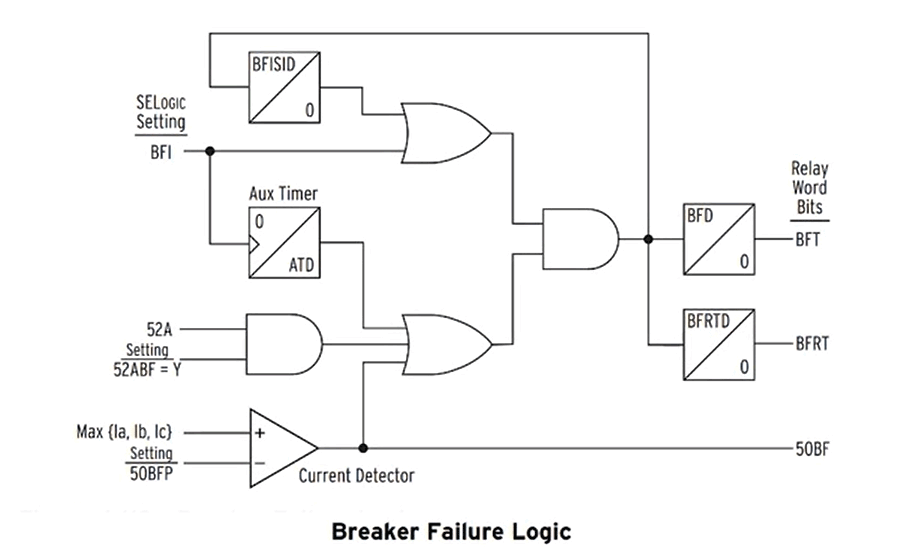
Circuit Breaker Failure Protection Logic. Photo: Schweitzer Engineering Laboratories
Clearing Time is Critical
The time taken to clear a fault when a breaker fails is critical to preventing system instability. The total clearing time is the sum of several components, each representing a step in the process:
-
Primary Protective Relay Time: The time for the primary relay to detect a fault and send a trip signal.
-
Breaker Failure Initiate Time: The time for the breaker failure logic to activate after the trip signal.
-
Breaker Failure Timer: A preset delay allowing the breaker to operate normally; if the fault persists, a failure is declared.
-
Trip or Lockout Relay Time: The time for the relay to send trip signals to backup breakers.
-
Local or Backup Breaker Interrupt Time: The time for backup breakers to open and stop the fault current.
The breaker failure timer is typically set longer than the normal breaker operation time to avoid false trips, with common settings ranging from 7 to 25 cycles, depending on the system. The total clearing time must be less than the critical clearing time (determined by system stability studies) to prevent cascading failures.
Backup Schemes for Breaker Failure Protection
To protect against breaker failures, two primary backup schemes are used:
1. Remote Breaker Failure Protection (BFP)
Remote protection uses over-reaching elements in adjacent zones to detect if a fault persists after the primary breaker should have cleared it. If the fault remains, remote breakers at other substations are tripped to isolate the fault.
Tripping remote breakers can cause outages over a larger area, affecting more customers than necessary. For instance, if a fault occurs between two breakers and one fails, remote breaker failure protection might disconnect entire substations rather than just the faulted line.
Remote breaker failure is common in systems where local communication infrastructure is limited.
2. Local Breaker Failure Protection (BFP)
Local protection relies on communication between relays within the same substation. When a breaker failure is detected, only the adjacent breakers necessary to isolate the fault are tripped, using shorter timers for faster response.
This method is more precise, minimizing outage scope and reducing clearing time due to direct relay communication. It is preferred in modern systems with microprocessor relays, which integrate the necessary logic, reducing costs and complexity.
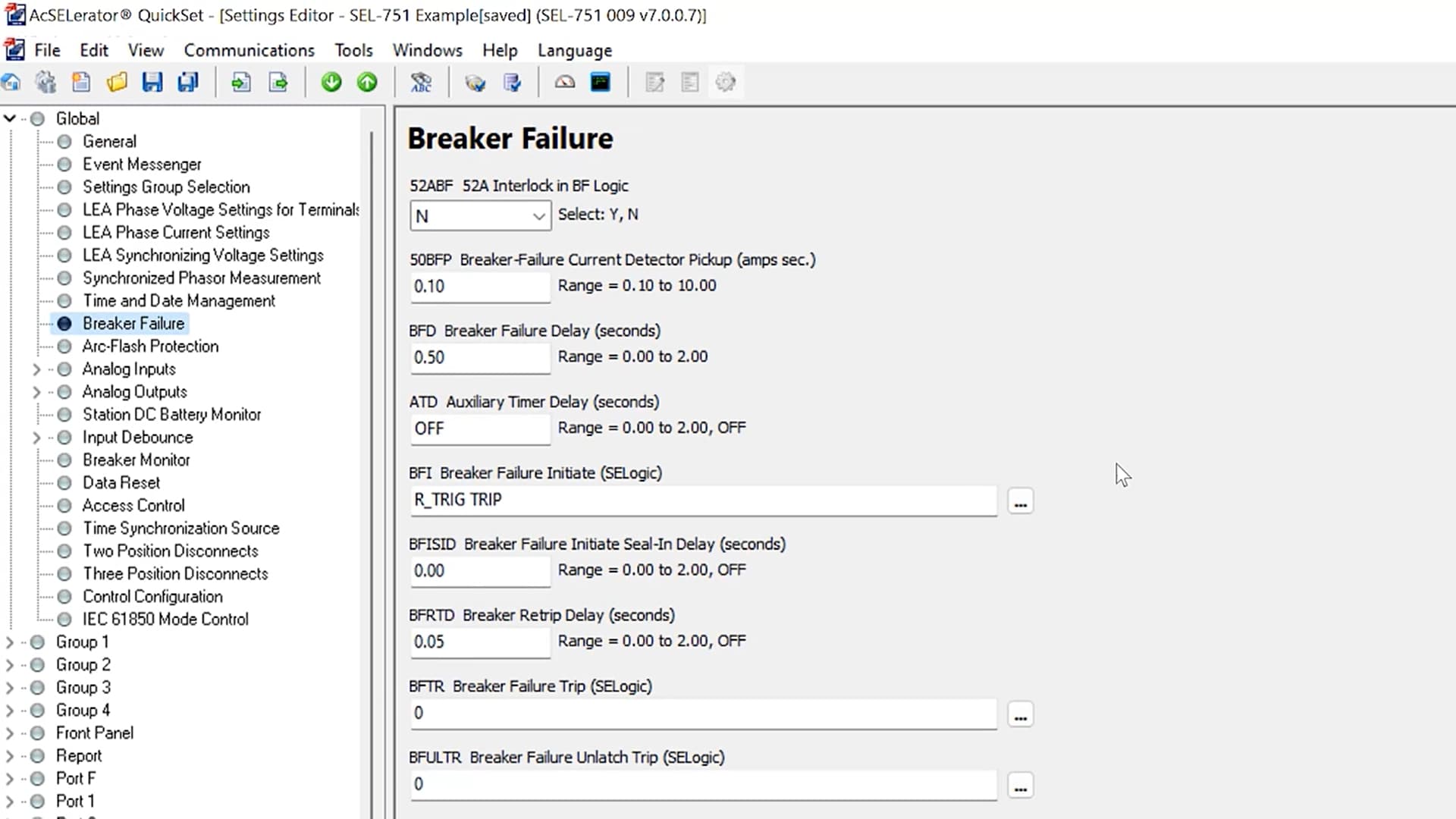
Breaker Failure Configuration Screen. Photo: Romero Engineering
Testing Breaker Failure Protection
Regular testing and maintenance is essential to help ensure breaker failure protection operates reliably during an actual system fault. Common testing methods include:
1. Manual Testing
Involves injecting a simulated fault and measuring the time from fault initiation to the breaker failure trip signal output. For example, technicians record the total time (e.g., 15 cycles) to verify correct operation.
2. Dynamic Testing
Uses state sequence tools to simulate various fault conditions, such as a 5% over-current state to confirm the system’s response. This method tests the breaker failure logic under realistic scenarios, ensuring accurate timing and response.
3. End-to-End Testing
Evaluates the entire protection system by simulating faults and verifying the interaction of all components, from relays to backup breakers. This comprehensive test ensures the system works as a whole.
Conclusion
Circuit breaker failure protection is a cornerstone of power system reliability, acting as a safeguard when primary breakers fail to operate. Regular testing confirms that the protection scheme operates within the required time frames and can handle real-world fault conditions.
The timing of fault clearing, the choice between remote and local backup schemes, and rigorous testing all contribute to maintaining a stable and safe electrical grid. Through careful design, implementation, and maintenance, breaker failure protection ensures that power systems can withstand faults without catastrophic consequences.